AI Writes the Code Now — Test Automation Matters More Than Ever
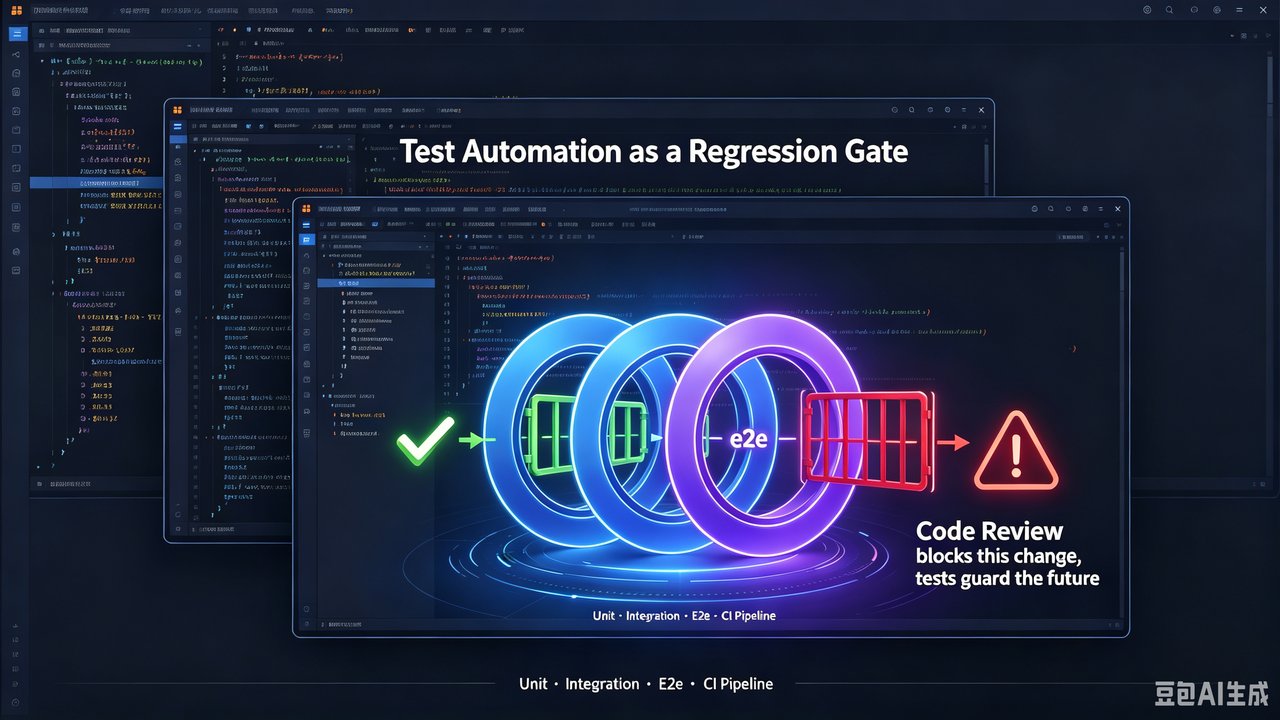
AI writes a feature, you’re happy. Two weeks later another task edits shared logic and the old feature silently breaks — you only find out from a user bug report. That’s regression: the defect isn’t in the writing, it’s in the changing. Code Review is a point-in-time gate; to guard the future you need a gate that keeps running.
First, a correction: AI makes testing matter more
Test automation was already one of the most important regression defenses long before AI-assisted coding. With AI, a common reaction is the opposite: “I don’t write the code anymore, so why should I worry about tests? The AI writes them.” That conclusion is backwards. Three structural shifts point the other way:
| Shift | Consequence | Effect on test automation |
|---|---|---|
| You no longer write code line by line | You used to hold an implicit dependency map in your head — which call sites a change would touch. Now the AI hands you a large diff and you have to re-read it just to learn which shared functions it touched. | Your control drops; an automated gate is the cheapest way to get it back |
| AI changes are bigger and more confident | One task can span a dozen files, and the model never gets the human “I shouldn’t touch this” nervousness. | The regression surface grows; manual review can’t cover it |
| AI is very good at making tests green | It will mock out the unit under test, copy the implementation into the assertion, or write smoke tests that assert nothing — then report “all passing.” | A green suite becomes deceptive; without a guideline you buy false confidence |
One line: AI drove the cost of writing tests down, and the risk of not having them up.
Approach: a 3-layer regression gate
Treat “add tests for this task” as a first-class quality action and front-load it at the same trigger point as review — after the feature builds and lints, before “done.”
| Approach | Pros | Cons | Fits |
|---|---|---|---|
| No tests, review only | zero extra cost | catches only this change | one-off, very low-risk |
| e2e only | closest to user | slow, brittle, expensive | a few critical business flows |
| 3 layers (unit + integration + tiny e2e) | complementary coverage, controllable cost | needs clear layer boundaries | evolving features/modules |
We pick three layers, with e2e kept extremely restrained: unit and integration form the everyday “always-running” body; e2e only covers the 1–3 paths users cannot lose.
- unit — pure functions, logic, edge cases. Fastest, cheapest; cover normal + boundary input (empty, out-of-range, exception branches).
- integration — cross-module and external contracts: DB read/write, API contracts, CLI/GUI parity, message formats. Guards that “the secret handshake between modules hasn’t changed.”
- e2e — only critical user paths (e.g. “login → core action → result”), run with a cheap model in CI, count ≤ number of critical paths.
The key move: humans plan, AI executes
Split “adding tests” into two layers:
- Execution — writing a runnable unit test, adding parametrized cases, wiring fixtures, fixing lint. AI is already excellent at this, often faster and more consistent than a human. Hand it over; don’t do it yourself.
- Planning — which surfaces does this module need covered? Which path is critical? How much e2e is enough? What makes a test valid? The AI doesn’t know by default; it guesses at “looks reasonable” — which produces random coverage, missing boundaries, and a pile of fake-green tests.
So the leverage is: humans freeze the plan into a written guideline; AI executes against it. The guideline buys two things — comprehensiveness and controllability.
Comprehensiveness = a coverage checklist, not AI improvisation
Don’t say “add some tests for this function.” Say “walk these 7 items; if one doesn’t apply, say why in the PR”:
- Normal input → an explicit expected value (not “it runs”)
- Boundary input: empty / 0 / 1 / max / out-of-range / very large & very small
- Illegal input → assert the specific exception type and message
- Failure paths: dependency timeout, partial failure, retries exhausted
- Idempotency: repeated calls produce the same result
- No state leakage: tests are independent, order-agnostic, parallel-safe
- Contract stability: field names, ordering, error codes, message formats
Controllability = the test must be able to fail
A test that cannot fail isn’t a guarantee, it’s decoration. AI is especially good at producing those, so hold the line:
- Mutation sanity check — before delivery, deliberately break the implementation a little (flip a condition, delete a range check, change a constant). The test must go red. Still green? It guards nothing; rewrite it.
- ❌ No assertion-less tests / bare
assert True/ print-only tests - ❌ Never mock the unit under test (only its external dependencies)
- ❌ Never copy the implementation into the assertion (
assert result == impl(x)) - ❌ No
sleep(n)to wait for async results (inject a clock or wait explicitly)
The guideline: a TESTING_GUIDELINE.md you can drop in your repo
# TESTING_GUIDELINE.md (read before adding tests — humans and AI both)

## Layer quotas
- unit 70% / integration 20% / e2e 10% (by case count, not by importance)
- e2e covers only the 1–3 "users absolutely cannot lose" paths; justify any addition

## Coverage checklist (answer each per unit; note any skip in the PR)
1. Normal input → explicit expected value
2. Boundaries: empty / 0 / 1 / max / out-of-range / very large & very small
3. Illegal input → assert specific exception type and message
4. Failure paths: timeout, partial failure, retries exhausted
5. Idempotent: repeated calls give the same result
6. No state leakage: independent, order-agnostic, parallel-safe
7. Contract stability: field names / order / error codes / message formats

## Validity red lines (violation = PR rejected)
- ❌ No assertions / bare assert True / print-only
- ❌ Mocking the unit under test (external deps only)
- ❌ Assertions copied from the implementation (tautology)
- ❌ sleep(seconds) to wait for async
- ✅ Mutation sanity check before delivery: break the impl → test must go red
Code: assertion-style unit tests cover boundaries
import pytest

def price_after_discount(base: float, pct: float) -> float:
    if pct < 0 or pct > 1:
        raise ValueError("pct must be in [0, 1]")
    return round(base * (1 - pct), 2)

def test_price_boundary():
    assert price_after_discount(100, 0.1) == 90.0
    assert price_after_discount(100, 0.0) == 100.0
    assert price_after_discount(100, 1.0) == 0.0
    for bad in (-0.1, 1.1):
        with pytest.raises(ValueError):  # assert the exception is actually raised
            price_after_discount(100, bad)
The last block isn’t “just run it and see” — it explicitly asserts the exception is raised. A test that only runs green without asserting isn’t holding the boundary.
Mutation sanity check: prove the test can fail
  def price_after_discount(base: float, pct: float) -> float:
-     if pct < 0 or pct > 1:
-         raise ValueError("pct must be in [0, 1]")
+     pass                       # mutation: drop the input validation
      return round(base * (1 - pct), 2)

# Expected: test_price_boundary must FAIL.
# If it still passes → the test is fake-green. Rewrite it; don't just revert the impl.
This is where “controllability” becomes real: it turns “I think it’s tested” into “I proved this test catches that error.”
Enforced rules
Layers & flow:
- Tests enter the same PR as code — front-load, don’t cram before release.
- e2e count restrained — as many as there are critical paths, no more.
- Gate green before review — machine first, then human review on blind spots.
- Run tests with cheap models / CI (echoes model tiering) — don’t burn premium quota.
Constraints on the AI:
- Guideline first, tests second — no TESTING_GUIDELINE.md, no unsupervised test generation.
- No assertion-less tests.
- Mutation sanity check before delivery — if breaking the impl doesn’t turn it red, it’s fake-green.
- Never mock the unit under test — external dependencies only.
Outcome (qualitative)
- Regression rate: caught before merge, not in production.
- Control restored: you don’t write every line anymore, but every change gets a machine restating which existing behaviors are still intact.
- Trustworthy tests: the mutation check filters “a pile of green tests” down to “tests proven to catch errors.”
- Review burden: lighter — the machine pre-filters routine regression; review focuses on design/consistency.
- Cost: transparent and near-zero, which is why it can run as often as review.
Reproduction checklist
- Drop a
TESTING_GUIDELINE.mdat the repo root (layer quotas + coverage checklist + red lines); read it before adding tests. - Pick a feature you’ll keep changing; list 1–3 “must-not-break” critical paths (e2e scope).
- Extract pure logic into testable functions; cover normal + boundary + exception branches.
- Add integration tests for cross-module / external contracts (DB, API, CLI-GUI parity).
- Add restrained e2e only for critical paths, run with a cheap model in CI.
- Run a mutation sanity check before delivery: break the impl, the test must go red.
- Tests enter the same PR; gate green, then independent review.
Conclusion & further reading
Code Review guards this change; tests guard the next one. And once AI writes the code, the gate matters more: plan with a guideline, let AI execute, keep e2e tiny, and prove the tests can fail. Pair it with Independent Code Review front-loading for the full pre-merge quality loop.
Note: this is a methodology write-up with qualitative observations; quantitative metrics (regressions caught pre-merge, suite runtime per PR, test-related credit share, fake-green hit rate from the mutation check) are best measured in your own setup. The
TESTING_GUIDELINE.mdabove is a template to adapt — the quotas and checklist should match your project’s shape.