Tools vs. Skills: The Real Difference Behind AI Execution
As the AI era settles in, we increasingly rely on AI to do things for us: run scripts, look up information, write code, deploy. But “AI does it for you” actually splits into two layers that many people conflate — one is a tool, the other is a skill. Telling them apart is the first fork in designing any AI automation.
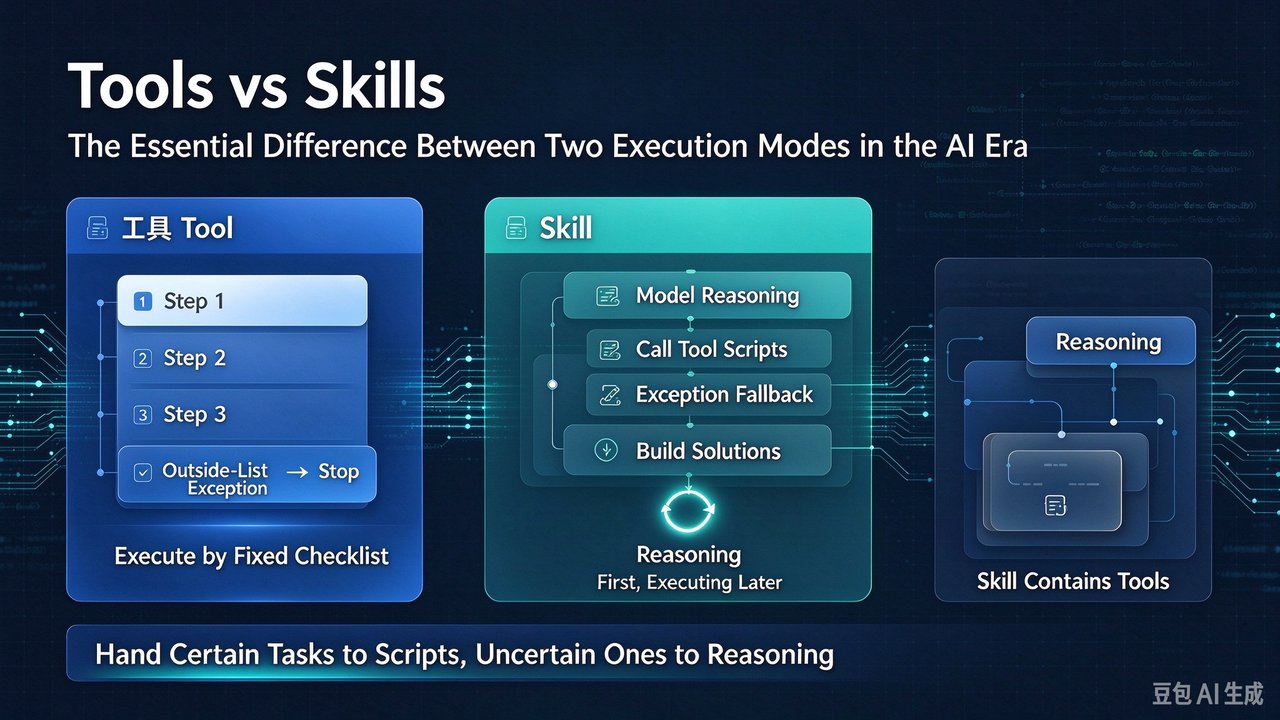
Core judgment: a tool runs a checklist and stops at exceptions; a skill wraps tool scripts with a layer of model reasoning that recovers, and writes the fix back into itself, getting smarter over time. The difference is not length — it is whether there is a reasoning layer.
Why this matters — the cost of the misconception
The cost of confusing them is concrete: hand a task that needs adaptability to a tool, and it stalls at the first out-of-checklist exception; push perfectly scriptable, deterministic work onto model reasoning, and the token cost spirals out of control. Drawing the boundary is how you decide what goes to determinism and what goes to intelligence.
This piece stays at the conceptual level — no implementation details of any specific product.
Mental model — the containment diagram
                  task request
        ┌───────────┴───────────┐
        ▼                       ▼
  ┌───────────┐          ┌──────────────┐
  │   Tool    │          │    Skill     │
  │ checklist │          │ reason first,│
  │ step by step│         │ then tools   │
  │ exception  │          │ exception    │
  │ → stuck    │          │ → recovers   │
  └───────────┘          └──────┬───────┘
                                │ still calls
                                ▼
                         ┌──────────────┐
                         │  tool scripts │
                         │ deterministic,│
                         │  saves tokens │
                         └──────────────┘
- A tool is an execution unit: inputs inside the checklist are executed strictly in order; the moment an uncovered exception appears, it has no second path.
- A skill is an orchestration unit: the model first judges what to do and how to adapt, then calls tool scripts to actually do the work.
- A skill still leans on scripts as much as possible: scripting costs far fewer tokens than reasoning step by step. Exceptions are the only place reasoning takes over — using the model’s own knowledge or fetching documentation live, rather than erroring out.
Mechanism — four layers
Layer 1: Tool — run the checklist
A tool’s behavior is a predefined sequence of steps. It is deterministic, cheap, and fast — but only as long as the world behaves as expected.
Layer 2: Skill — reason first, execute after
A skill first has the model understand the goal and break it down, then calls internal tool scripts. Scripts do the deterministic heavy lifting; the model handles the uncertain judgment.
Layer 3: Exception fallback — reasoning enters
This is the watershed between tool and skill. A tool stops at an exception; a skill hands the context to model reasoning, which may solve it from existing knowledge or fetch docs live, then adapt the plan and continue.
Layer 4: Self-evolution — write the fix back
When a skill reasons through a genuinely new problem, it doesn’t treat the fix as a one-off rescue. It bakes the experience into itself — updating its flow, rules, or a tool script — so the next identical case hits directly instead of being re-reasoned. A tool never learns, because its checklist is frozen; a skill gets smarter because every recovery rewrites it a little.
# Tool: run the checklist, stop on failure
for step in CHECKLIST:
    run(step)                  # stops, no fallback

# Skill: tools + reasoning fallback + self-evolution
for step in plan:
    if not run_tool(step):
        clue = model.reason(context)      # knowledge or live docs
        plan = model.replan(plan, clue)   # adapt and continue
        skill.learn(step, clue)           # bake the fix in
Notice lines 3 versus 6 and 7: the tool terminates on line 3; the skill hands the failure to reasoning on line 6 and writes the fix back on line 7 — one buys continuity of the run, the other buys “no need to think next time.”
Common misconceptions — four clarifications
- “A skill is just a longer tool checklist.” No. A longer checklist is still static; the reasoning layer lets it change its mind at runtime — which is exactly what handles out-of-checklist exceptions.
- “With skills, tools become useless.” The opposite. Deterministic, repeated steps belong in scripts, where the token cost is lowest; the skill’s value is in exceptions and judgment, not in stealing the tool’s job.
- “A skill can handle everything on its own.” Not quite. When it acts, it still calls tool scripts — the model thinks, the script does; without the execution layer, reasoning is just talk.
- “A skill re-reasons from scratch every time.” No. The fix is written back; the next identical case is a direct hit, no temporary reasoning needed.
When to apply — a split checklist
- When designing an AI automation, ask per step: “Is the outcome of this step deterministic?” Yes → tool script; No → the skill’s reasoning layer.
- If a task keeps stalling on some “out-of-checklist exception,” that’s a clear signal to upgrade the tool into a skill.
- If you care about token cost, sink scriptable parts as deep as possible and let the model act only on exceptions and decisions.
- At selection time, ask two questions: will an exception appear? Will resolving it require looking something up? If either answer is “yes / needs to,” choose a skill.
Summary
- A tool runs a fixed checklist and stops at exceptions; a skill wraps tool scripts with model reasoning that recovers and writes the fix back into itself — so a skill contains tools and evolves.
- The most practical takeaway: give deterministic steps to scripts, uncertain steps to reasoning; don’t waste intelligence where a checklist already suffices.
- Next time you design an automation, ask: “Will this step hit an out-of-checklist exception?” If it needs to save itself, hand it to a skill.
If you’ve hit the “tool stalled” or “token spiral” trap while building AI automation, I’d love to hear about it in the comments.