Pilot Before You Scale: Controlling Rework in AI Batch Workflows
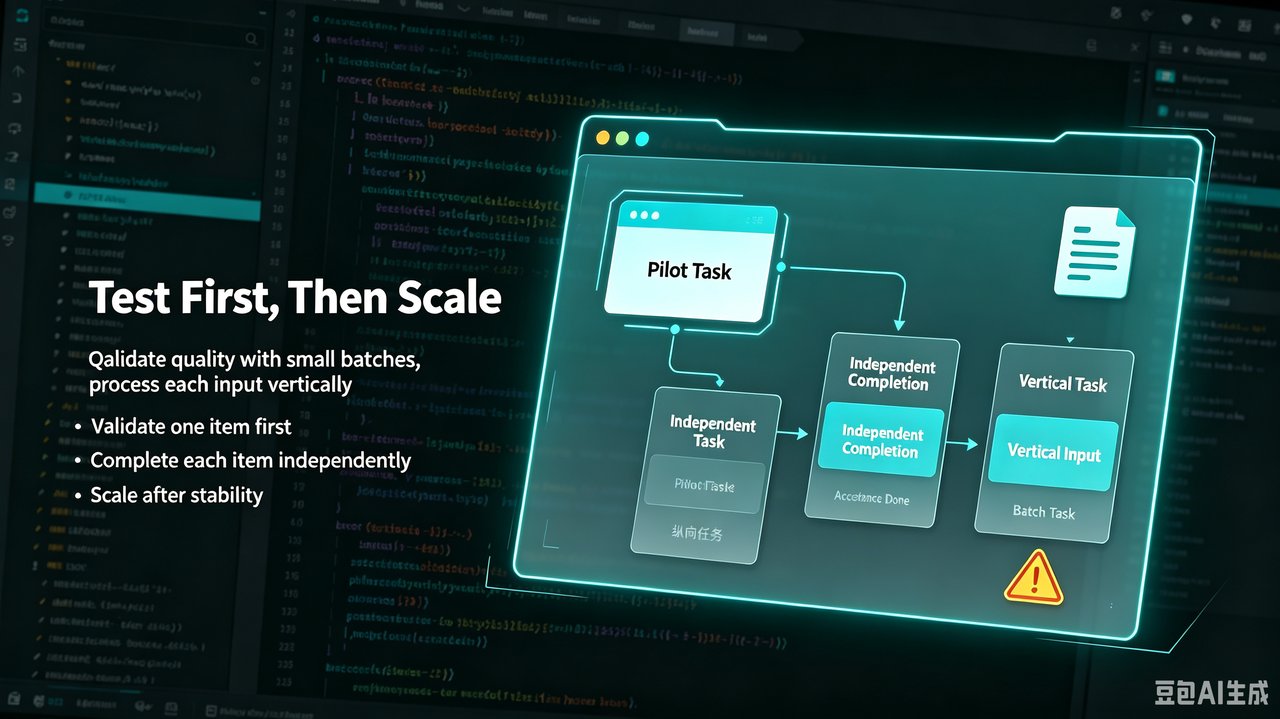
When you apply one AI pipeline to a batch of similar inputs — 100 files, a set of modules, a pile of copy — the two most common “at scale” approaches, firing everything at once and marching in lockstep, both amplify losses when a process defect surfaces mid-run. This article lays out a pilot-then-vertical rhythm that shrinks the rework blast radius to a single input, and spells out the preconditions for horizontal speed-ups.
Why “at scale” approaches amplify losses
Anti-pattern A — fire all at once. Feed all 100 inputs through the full pipeline. Input #30 has an unusual format and the process breaks. The first 29 outputs are complete but unverified — likely all wasted. You paid for 100 runs and only confirmed the pipeline runs, not that it runs well.
Anti-pattern B — step-lateral (march in lockstep). All inputs do step 1, then all do step 2, and so on. When input #7 exposes a defect at step 2 (missing dependency, bad format), every step-1 output from inputs #1 through #100 is already spent — and potentially invalidated by that same systemic defect. One defect, total rework.
Both share the same root cause: full cost is committed before the process is validated.
The three rollout rhythms, compared
| Approach | Pros | Cons | Fits |
|---|---|---|---|
| Fire all at once | Looks fastest | Mid-run break wastes everything; full cost paid upfront | Homogeneous inputs, validated process |
| Step-lateral (lockstep) | Easy to reuse intermediate results | One defect → total rework | Rock-solid process, homogeneous inputs |
| Pilot + vertical rollout | Smallest rework blast radius | One extra pilot run upfront | Diverse inputs, process not yet stable |
✅ Vertical:     input1[step1→step2→step3 done] → input2[…] → input3[…]
❌ Step-lateral: all inputs step1 → all inputs step2 → all inputs step3
For any process that hasn’t proven itself stable, pilot-then-vertical is almost always cheaper — one pilot run blocks N rounds of rework.
The rhythm in three moves
- Pilot. Pick the single most representative input and run it through the entire pipeline. Verify quality by hand against an acceptance checklist — confirming it ran correctly, not just ran. Only then scale.
- Go vertical (per-input). Each input completes the full pipeline before the next one starts. The property you’re buying is failure isolation: a defect in one input affects only that input.
- Horizontal exception. Only when the process has survived a few clean rounds, is locked down by acceptance assertions, and the inputs are homogeneous, is a horizontal speed-up worth it. Until then, horizontal is not the default.
Three design rules:
- Pilot before scale — run one representative input end to end, verify by hand, then roll out.
- Vertical independence — each input runs the full pipeline on its own; a failure stays isolated.
- Stability precedes horizontal — assertions locked down + homogeneous inputs, or no lockstep.
This rhythm is older than AI
It’s the same discipline engineering and organizations have always used, and AI merely made it mandatory again:
- Refactoring shared modules: branch first, wire in one consumer module, validate, then switch everyone over. Same rhythm with AI — or your AI cost runs away from you.
- Policy rollouts: pilot in a few cities, evaluate, then expand nationally.
Faster generation means faster mistakes; bigger batches mean a bigger bill for a single process defect. Piloting isn’t the slow option — it’s the cheapest fast option.
Making “ran correctly” checkable
Vertical rollout only holds if “correct” is defined, so turn it into an assertion checklist you can reuse across jobs:
- Completeness — every input maps to exactly one output, with IDs lining up: no misses, no duplicates.
- Format — fields complete, naming and structure match the agreed sample; compare against the one output you verified by hand.
- Facts — proper nouns, numbers, and references in the output match the input: no model-fabricated content.
- Consistency — similar inputs that hit similar issues get the same treatment, never “same question, different answer”.
- Boundaries — empty or malformed inputs produce an explicit fallback, not a silent skip or a vague error.
- Traceability — each output records its input hash and pipeline version, so you can tell which version produced what.
Format and structure checks can be scripted with tools like diff and jq; fact checks stay human — that split is the gate between “it finished” and “it finished correctly”.
# ✅ Vertical: run one, verify it, only then move on
for input in batch/*; do
  run_pipeline "$input"              # step1→step2→step3 in one pass
  if ! run_assertions "$input"; then # against the acceptance checklist above
    echo "FAIL: $input → fix and rerun only this one; finished work stays"
    break
  fi
done
One-line principle: verification isn’t “it finished” — it’s “it finished correctly”, and the assertion checklist is what makes the latter checkable. Batch scripts can wait until a few clean rounds and homogeneous inputs; until then, one pilot costs less than N reworks.
Payoffs and a trackable metric
- Trial cost: 1 run catches what would have cost 100 runs of rework → unit cost per usable output drops.
- Blast radius: lockstep turns one defect into total rework → vertical contains it to a single input.
- Verification certainty: “it finished” → an acceptance checklist confirms “it finished correctly”.
Track this metric: the number of inputs reworked or discarded due to process defects during rollout. Fire-all and lockstep typically cost N; vertical typically costs 1 (the pilot). After publishing, also compare acceptance pass rates between pilot samples and full-batch samples to confirm the pilot really catches systemic issues.
Rollout checklist
- Pick the most representative input; run the full pipeline and verify by hand (against your acceptance checklist).
- Then run inputs one by one — no “pre-process everything first”.
- Push each input independently; fix failures per input without dragging finished ones back.
- After 3 clean rounds, consider batching/scripting.
- Book the pilot cost into the total: 1 pilot blocks N reworks.
- Confirm you’re rolling out vertically (per input), not in lockstep.
Conclusion and further reading
- Pilot before scale: one representative input, end to end, verified by hand — then roll out.
- Roll out vertically, not laterally: per-input completion keeps failures isolated and the blast radius minimal.
- Stability precedes horizontal: assertions + homogeneous inputs first; one pilot blocks N reworks.
Before your next AI batch job, run the nastiest input first — verify it against your assertion checklist, then scale. This article is part of the AI Cost-Effective Usage Strategy series; more engineering-practice pieces live in the site’s knowledge base.